Typical Issues and Solutions for PCB Assembly
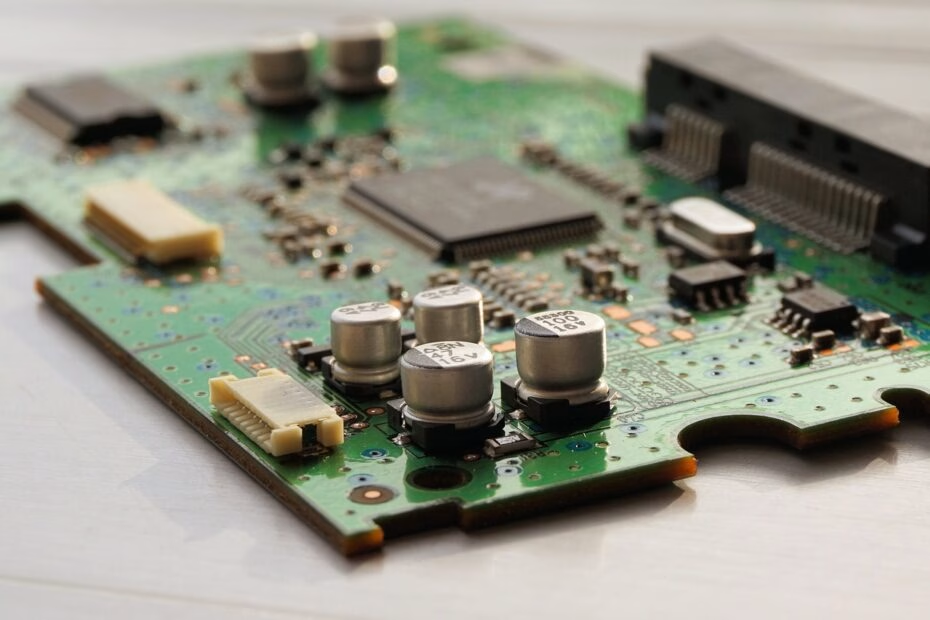
Through precise circuit design and component integration, PCBA (Printed Circuit Board Assembly), the “nerve center” of electronic devices, makes signal processing, power distribution, and functional control possible.
Numerous procedural and technical difficulties in its process have an immediate effect on the dependability, quality, and production efficiency of the final product. Common problems and associated technical analysis are listed below.
1.Incoming Material InspectionStage
1.1 Common Issues
1.1.1 Packaging & Component Appearance Defects
Physical damage: Chipped or bent bodies, padsless or bent leads, or cracked packages as a result of improper handling or transport (e.g. QFP/TQFP Pins misaligned or BGA Balls missing).
Corrosion/Oxidation: Surface contamination due to moisture or tarnished lead (e.g. copper oxidation at uncoated terminals).
Labeling errors: Incorrect or missing part numbers, lot code, or polarity markings (e.g. reverse silk-screening on diodes/capacitors), resulting in misidentification of components during assembly.
Packaging Issues: Damaged reels/trays, or improper anti-ESD packing for sensitive devices, e.g. MOSFETs and ICs.
1.1. 2 Dimensional and Specification Mismatches
Footprint discrepancies: Inconsistencies in SMD component dimensions or lead pitches, e.g. SOIC-16 with 1.27mm and 2.54mm spacing, compared to Gerber/BOM files.
Polarity/ Orientation errors: Unmarked polarities, reverse-marked diodes or misaligned Pin 1 indicators on ICs can cause functional failures after soldering.
Material composition issues: Noncompliant substrates, such as FR-4, instead of the specified high-Tg materials for high-temperature application, or incorrect plating, such as tin-lead finishes instead of pure tin.
1.1. 3 Electrical & functional Failures
Deviations in Parameters: Out of tolerance values (e.g. resistors >5% from their rated value or capacitors with ESRs exceeding specs), or unstable performance.
ESD-Induced Damage: Latent defects in electrostatic-sensitive devices (ESD-SD) like CMOS ICs, where internal die cracks or gate oxide breakdown occur during handling but only manifest during functional testing.
Short/Open Circuits: Faulty connectors or multi-lead components with faulty connections (e.g. bridging of IC pins caused by manufacturing defects).
1.1. 4 Environmental Risks
Moisture-Sensitive: Inadequate packaging of MSL 3+ (e.g. QFN, BGA) components, leading to delamination during reflow or “popcorning”.
Poor Solderability: Insufficient tinning of leads (e.g. nickel plating thickness less than 5mm) or contamination (e.g. oil residues on terminals), leading to non-wetting joints or cold joints.
Thermal/Mechanical vulnerabilities: Components that fail to meet the temperature cycling requirements. (e.g. resistors breaking under tests from -40degC up to +85degC) or mechanical stresses (e.g. connectors with an insufficient retention force).
1.1.5 Additional Material Issues
Adhesive failure: Low post-cure bonding strength (5MPa), or Tg below standard.
Cleaning agent residue: Ionic contamination exceeding IPC5701 limits (=1.56mg/cm2 equivalent NaCl).
1.1.6 Documentation and Compliance Gaps
Missing certifications: Absence of RoHS/REACH reports, AEC Q100 automotive qualifications or military grade (MIL-SPEC test data) for specialized applications.
Lot Tracking Issues: Inconsistent codes on components and delivery documents making it difficult to trace back failures to specific manufacturing batches.
Counterfeit parts: Substandard components or fraudulent components, often detected by XRF analysis of material or die photography.


评论
发表评论