Complete Handbook on PCB Assembly Testing in 2025
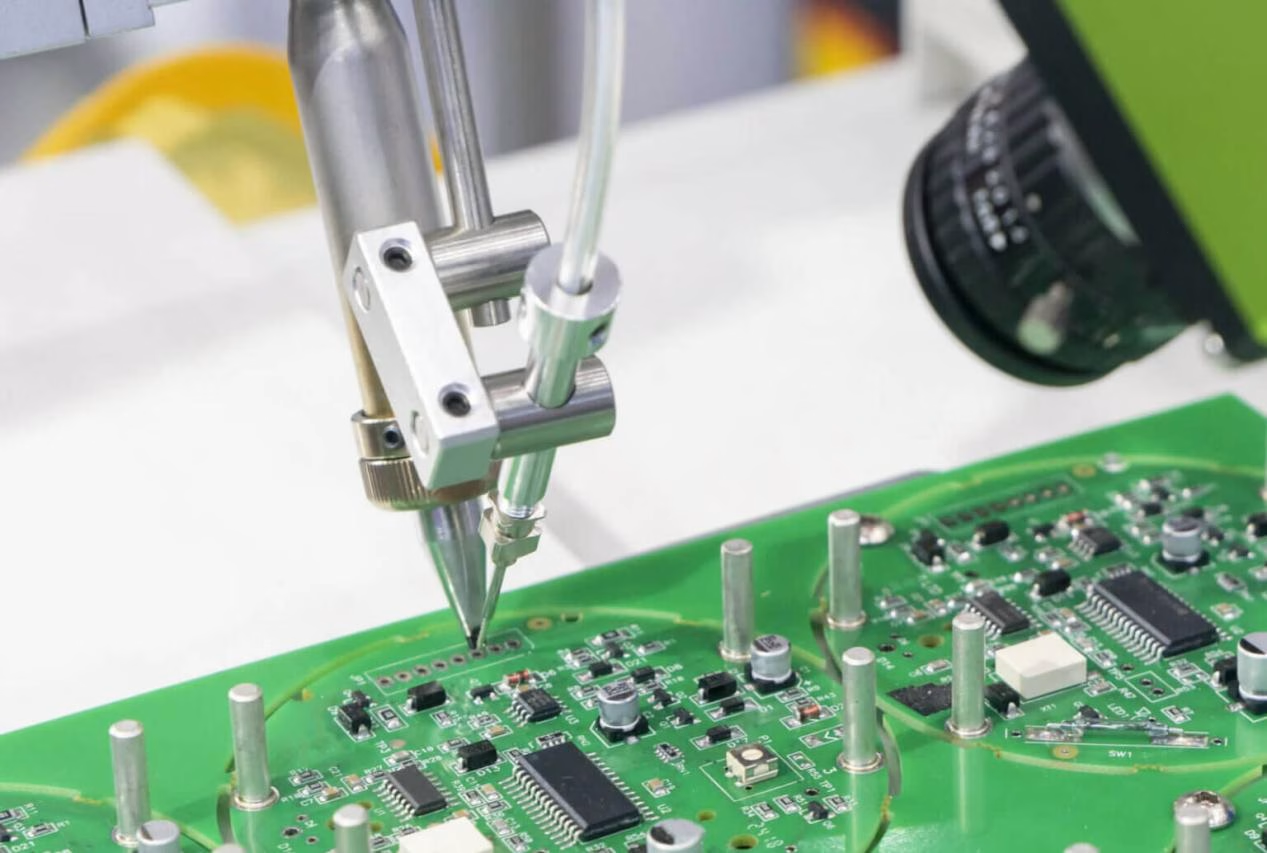
PCB assembly testing techniques are essential to the manufacturing workflow.
We continuously adjust and improve our testing approaches alongside our failure analysis. Below, we provide detailed descriptions of various PCB testing methods. This guide is intended to give a precise and instructive synthesis of these findings.
1.Incoming Quality Control
(1) Purpose : PCB assembly materials consist of PCB substrates and electronic components.
Make sure the materials you’re employing meet all performance, specification, and reliability requirements.
(2)Inspection Content:
Inspecting incoming materials allows you to spot some errors ahead of time.
Prior to assembly, you must inspect the component’s packing and silkscreen. If the component’s pins rust, you must notify the provider and make an order for replacements on time.
Before assembling the components, make sure that their electrical properties fit the norm.
Before assembling the PCB, ensure that the pad flatness and thickness are correct.Check the surface coating and via quality.
2.Stencil Inspection
(1) Your purpose: you must make sure that the stencils are clean. Make sure that the SMT stencil tension, and aperture accuracy are within specified parameters.
(2)Inspection Content:
Verify stencil opening dimensions match design-specified process parameters. Tests include the shape, tolerance of placement, and aperture size.
Make sure the stencil is free of impurities and solder paste residue.Check stencil tension with a tensiometer to ensure consistent printing.

incoming quality control and stencil inspection
3.Solder Paste Inspection (SPI)
(1) Use: You need to check the quality of solder paste. It can help to avoid many soldering errors. This includes excessive soldering, insufficient soldering, bridging and misalignment.
(2)Inspection Content:
Inspection Content: Check that the paste volume and thickness meet the standards. Place the solder correctly. The solder paste shape should also correspond to the print parameters.
You should correct the misplaced solder paste as soon as feasible.
You should also check for edge clarity and bridging.
4.In-line automated optical inspection (In-line AAOI)
(1) Use: Reflow soldering allows you to spot surface mounted faults immediately. This provides rapid feedback on the procedure. AOI inspects PCBs with 2D and 3D cameras. The board isn’t powered, and several components are missing.
(2)Inspection Content:
In-line AOI allows you to spot misplaced or missing components immediately. This is also useful for determining component polarity, skewing, and tombstoning.In-line AOI allows you to spot flaws early. You may quickly rework issues like bridging and pad contamination.
AOI systems use machine vision and cameras to detect faults. Open circuits, pad damage, lead deformation and other defects can be detected quickly. It helps reduce the errors and costs that come with PCBs with defects.

solder paste inspection and in-line automated optical inspection
5.SMT First-Article Inspection (FAI).
(1) Purpose :Before mass-production, you should verify that the production process is correct. You can then verify that the PCB is assembled correctly. This will prevent errors in batches.
(2)Inspection Content:
Verify the BOM to ensure that the component mounted is the proper model. The polarity and component package must also be evaluated.
In addition to the X/Y offset, the rotation angle is factored into the placement accuracy. If the machine’s accuracy is off.
It should be debugged.QFP and BGA parts require coplanar pads and leads. If you don’t, it’s quite easy to spot soldering flaws.


评论
发表评论